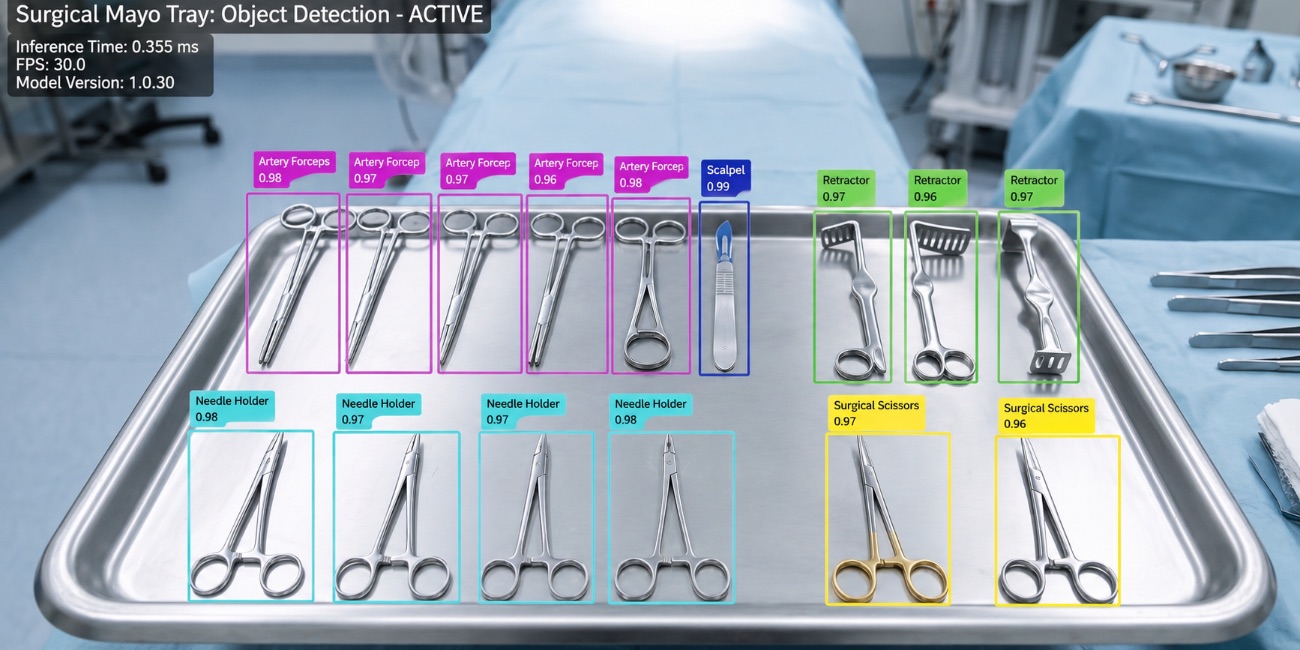
There is a wide gap between a computer-vision demo that lights up bounding boxes on a recorded clip and a system a surgeon will rely on with a patient on the table. Closing that gap is most of the work — and almost none of the marketing.
Vision in the operating room is not judged on average accuracy. It is judged on the worst case, at the worst moment, under the worst lighting. That changes how you build everything.
Latency is a clinical requirement
A model that is accurate but late is useless in a procedure. Guidance has to track the scene in real time, on hardware that fits in a sterile environment, with no round-trip to a distant server. We optimize for the latency budget first and design the model to live within it — not the other way around.
The hard cases are the whole job
Smoke, blood, glare, occlusion, an instrument half out of frame — these are not edge cases in surgery, they are Tuesday. A system trained only on clean footage will fail exactly when it matters. Representative data, including the messy and the rare, is what earns trust.
In the operating room, the question is never “how good is it on average” — it is “what happens on the worst frame of the worst day.”
Keep the clinician in command
The goal is not to replace judgment. It is to surface the right information at the right moment and stay out of the way otherwise. Confidence has to be legible, overrides instant, and the system honest about what it cannot see. Vision that quietly hides its uncertainty is more dangerous than no vision at all.
That discipline — latency budgets, worst-case data, legible confidence, human command — is what separates a vision system that demos well from one that belongs in a clinical setting. It is the standard we hold our own work to.