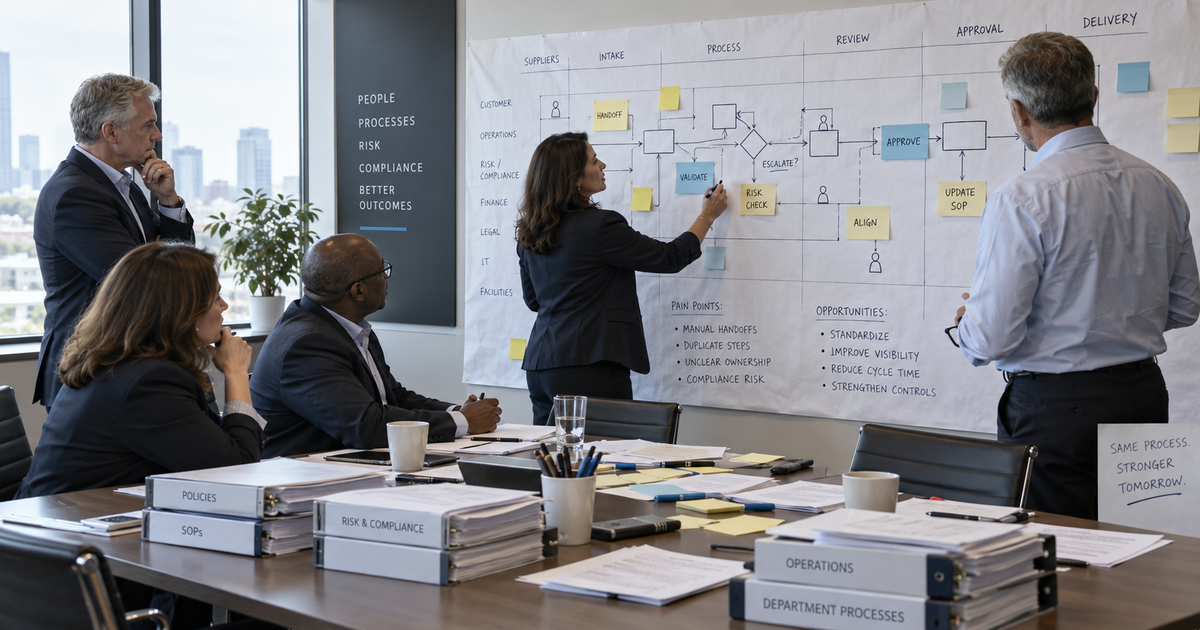
In a single week in June 2026, IBM, Google, Microsoft, SAP, AWS, and Celonis all released major announcements around the same thesis: AI fails at scale without organizational context. Not better models. Not bigger datasets. Context — the kind that lives in people’s heads, in undocumented handoffs, in the gap between how leadership thinks the operation runs and how it actually runs. The largest players in enterprise technology just converged on the exact principle that has governed how we approach AI deployment for the past twelve years.
This is not a coincidence. It is an inflection point. And it validates a position that was, until very recently, considered contrarian: you have to map the work before you automate it.
What the announcements actually said
The convergence is striking because these companies arrived at the same conclusion from different directions.
Celonis cited research showing that 85–90% of enterprise AI deployments fail because they operate on raw data without understanding how the organization actually works. Their argument is that process intelligence — knowing what happens, in what order, by whom, and why — is the missing prerequisite for effective AI. Without it, you are pointing powerful models at problems you have not properly defined.
IBM and Google launched a multi-billion-dollar consulting partnership built on a specific premise: that human expertise must bridge the gap between what AI can do technically and what an organization actually needs. The partnership is not about better infrastructure or cheaper compute. It is about putting experienced practitioners in front of AI deployments to capture the organizational knowledge that no database contains.
Microsoft built an entirely new intelligence layer — Microsoft IQ — designed to give AI systems the business context they need to produce useful outputs. The product exists because Microsoft recognized that even the most capable models generate noise when they lack an understanding of how a specific organization operates.
AWS rebuilt their migration and modernization platform around agentic AI, but with an important caveat: the system’s first step is deep discovery and mapping of the target environment before any automation runs. The architecture assumes that you cannot automate what you have not mapped.
SAP, at Sapphire 2026, doubled down on embedded AI that understands enterprise workflows end to end — not AI that sits on top of data, but AI that is wired into the actual processes it needs to augment.
Every one of these announcements, from companies that collectively represent trillions of dollars in market capitalization, points to the same conclusion: the bottleneck is not the AI. The bottleneck is understanding the organization well enough to deploy AI where it matters.
Why this matters more than most industry news
Enterprise technology announcements are usually about features, pricing, or partnerships that sound impressive in a press release and change nothing on the ground. This is different. When six of the largest companies in enterprise tech independently arrive at the same structural diagnosis — and invest billions of dollars behind it — they are not following a trend. They are acknowledging a failure pattern that has been hiding in plain sight.
The data has been clear for a while. MIT found that 95% of generative AI pilots produce no measurable profit. S&P Global reported that 42% of companies abandoned most of their AI projects in 2025. IBM surveyed more than 2,000 CEOs and found that only 25% said their AI initiatives delivered expected ROI. Gartner projects $2.59 trillion in global AI spending in 2026 — most of it heading toward the same outcomes that produced those failure statistics.
What the researchers attributed the gap to was not model quality, not data availability, not engineering talent. It was “poor workflow design, not weak AI models.” The organizations that succeed with AI are the ones that understand their own operations deeply enough to know where AI creates value and where it creates waste.
The organizations that succeed with AI are not the ones with the best models. They are the ones that mapped the work first.
The discovery gap
There is a specific piece of organizational knowledge that AI systems cannot access from data alone: how the work actually gets done. Not the process documentation version, which is usually outdated the day it is written. Not the org chart version, which describes reporting lines but says nothing about who actually makes decisions. The real version — the one that lives in the heads of the people who do the work every day.
This includes questions that no event log or database schema can answer:
- Which steps in a process exist only because of a workaround someone created years ago?
- Where do decisions actually get made, and by whom?
- Which handoffs create delays that nobody has measured?
- What institutional knowledge would be lost if a key person left?
- Which processes look efficient on paper but consume enormous time in practice?
This is the gap that Celonis identified when they said AI fails without context. It is the gap that IBM and Google are spending billions to bridge with human expertise. It is the gap that Microsoft is trying to close with an intelligence layer. And it is the gap that a structured discovery process is specifically designed to fill.
Why dashboards and data lakes do not close this gap
A common objection is that organizations already have this context captured in their systems — in ERP data, CRM records, support tickets, and business intelligence dashboards. They do not. Those systems capture transactions and events. They do not capture reasoning, judgment, or the informal knowledge that determines how work actually flows.
A dashboard can tell you that order processing takes an average of 4.2 days. It cannot tell you that the delay happens because one person in the finance department manually verifies every order over $5,000, a process that started as a temporary measure during an audit three years ago and was never removed. That kind of context — the kind that determines whether automating order processing will save time or break a compliance requirement nobody documented — only comes from structured conversations with the people involved.
This is exactly what the big players are now building toward, and what a disciplined discovery phase captures systematically.
What discovery-first looks like in practice
A structured discovery engagement is not a survey. It is not a workshop with sticky notes. It is a systematic process for extracting the organizational knowledge that determines whether AI deployments succeed or fail.
In a typical engagement, this means conducting 15 to 20 structured interviews across the organization — not just executives, but the people who actually do the work. Operators, coordinators, field staff, middle managers. The interviews are designed to surface the real workflow, not the theoretical one. They capture how decisions get made, where bottlenecks exist, what information is missing, and where judgment calls happen.
The output is a complete process map paired with a prioritized automation catalog. Every opportunity is scored across three dimensions:
- Impact — What does this process cost today in time, money, and error rate? What is the realistic dollar value of improvement?
- Feasibility — Is this a structured, repeatable process that AI can handle reliably? Or does it require the kind of contextual judgment that models cannot replicate?
- Risk — What is the cost of getting it wrong? A misfiled document is a different risk class than a miscalculated patient dosage.
The result is not a report that sits on a shelf. It is a ranked list of the three to five automation projects that will deliver the highest return, with clear baselines to measure against and clear risk profiles to govern against. Everything that follows — architecture, build, deployment, governance — is grounded in evidence rather than assumption.
The diagnostic before the surgery
We describe this approach with a metaphor that captures the logic precisely: run the diagnostic before the surgery. No competent surgeon operates without imaging, labs, and a clear understanding of what they are working with. The diagnostic does not slow down the surgery. It makes the surgery possible.
The same principle applies to AI deployment. Two to three weeks of structured discovery produces the organizational intelligence that most AI projects skip entirely. It surfaces the high-value opportunities that are invisible without the map. It identifies the projects that sound exciting in a demo but would fail in production. And it establishes the governance boundaries that prevent the kind of ungoverned execution that turns AI from an asset into a liability.
This is not a new idea. It is the approach that has separated successful AI deployments from failed ones for years. What is new is that the largest companies in enterprise technology are now saying the same thing, publicly, and investing billions behind it.
What this means for operations leaders
If you are a COO or VP of Operations evaluating AI investments, the convergence of these announcements carries a specific, practical implication: the discovery phase is not optional overhead. It is the structural prerequisite for AI that works.
The companies that skip it — that start with a tool, point it at the loudest complaint, and hope for the best — are the ones that populate the 95% failure statistics. The companies that invest two to three weeks in understanding their own operation before writing a single line of automation code are the ones that deliver measurable ROI.
The biggest names in enterprise tech just validated that thesis with multi-billion-dollar investments. The question for any operations leader is straightforward: are you going to map the work first, or are you going to join the 95% that did not?
If your organization is planning an AI initiative, or trying to understand why the last one did not deliver, start with the diagnostic. Map the processes. Score the opportunities. Build only what the evidence supports. It is not the exciting part. It is the part that works.